
Shoulder Pain Treatment in Guelph & Wellington County
From rotator cuff tears to frozen shoulder, our physiotherapists diagnose the source of your shoulder pain and build a plan to get you moving again. No referral required.
. No Referral Needed.
Convenient billing available with most major insurers











If you don’t see your provider listed, give us a call to confirm. Learn more about convenient billing.
Shoulder pain is one of the most common complaints we treat at Eramosa Physiotherapy Associates through our Path to Improved Health. For over 30 years, Eramosa Physiotherapy has offered physiotherapy and treatment for shoulder concerns including shoulder pain, frozen shoulder, rotator cuff tendonitis, rotator cuff tear, impingement syndrome, pre- and post-shoulder surgery, and shoulder dislocations and separations.
Shoulder pain can be as minimal as a quick intermittent pain, often described as a ‘sharp catch’, but can progress to a more constant dull ache down the arm. Commonly, shoulder pain results in aching that disrupts sleeping postures and leads to restless sleeps and increased pain at night.
Problems in the shoulder can occur with everyday wear and tear, overuse, or an isolated injury. While there are many causes of shoulder pain, an accurate diagnosis is essential so that the appropriate treatment is implemented.
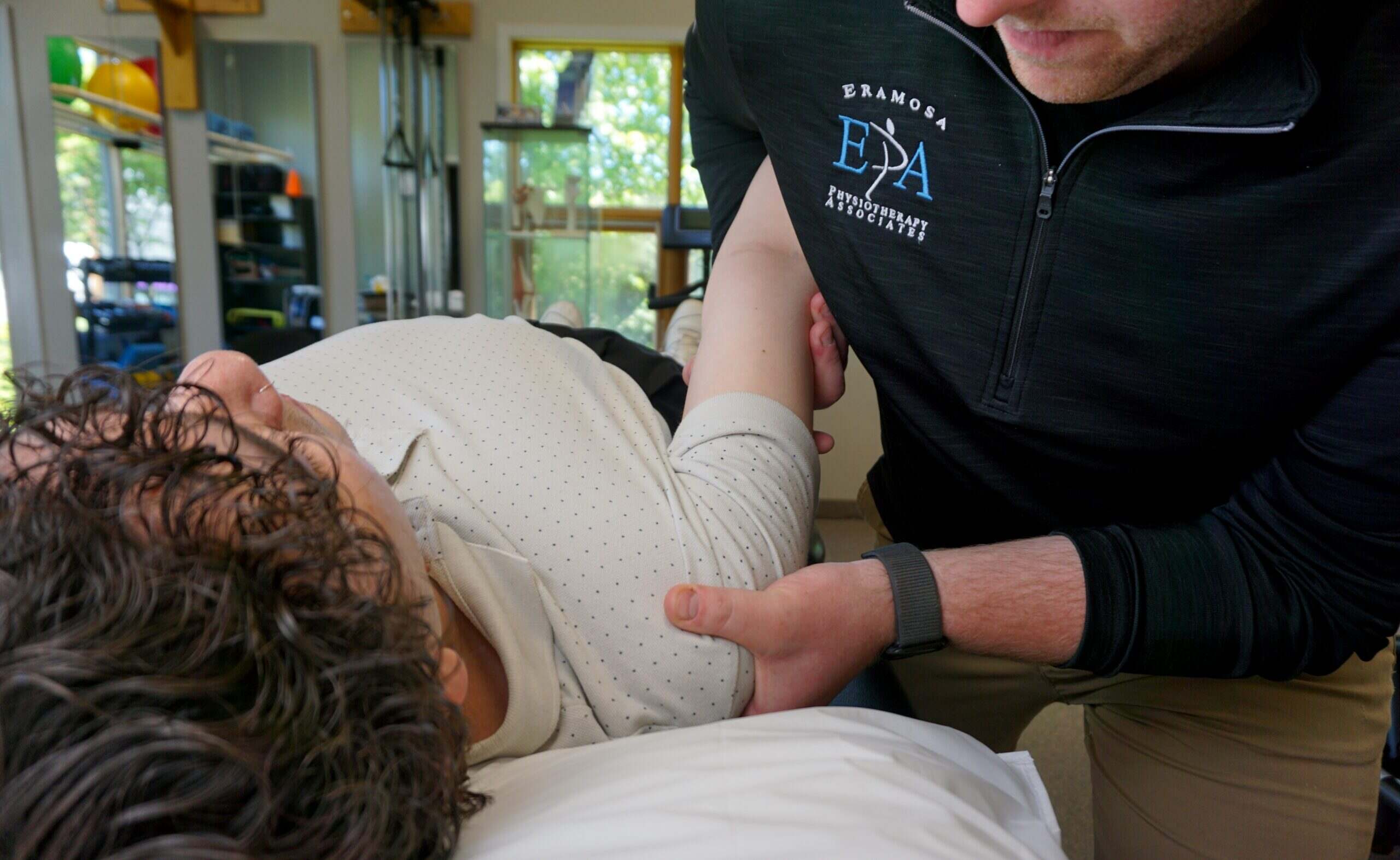
Common causes of shoulder pain
The shoulder is the most mobile joint in the body — and that mobility comes at the cost of stability. It relies heavily on the surrounding muscles, tendons, and ligaments to function, which makes it vulnerable to a wide range of injuries and conditions. Accurate diagnosis is what determines whether physiotherapy will be effective and how quickly you’ll recover. Common diagnoses include:
- Weakness of the rotator cuff and shoulder muscle
- Weakness of the shoulder blade muscles
- A stiff shoulder joint
- Imbalances between shoulder muscle groups that results in poor arm and shoulder blade movement
- Poor posture, such as an increased rounding of the shoulder blades
- Trauma, such as a fall, involving the arm
- Shoulder surgery
Medical diagnoses for shoulder pain
Shoulder pain can stem from several specific medical conditions. Each one has its own causes, symptoms, and treatment considerations — accurate diagnosis is what determines whether physiotherapy will be effective and how quickly you’ll recover.
- Rotator cuff tendonitis — inflammation of the rotator cuff tendons, usually from overuse or repetitive shoulder motion
- Rotator cuff tear — partial or complete tear of one or more rotator cuff tendons, often from sudden injury or wear
- Shoulder impingement syndrome — pinching of the rotator cuff tendons between bones, causing pain with overhead movement
- Frozen shoulder — progressive stiffness and pain caused by inflammation of the shoulder capsule
- Shoulder dislocations and separations — joint or ligament injuries from impact, falls, or sports trauma
How we treat shoulder pain
Through our Path to Improved Health, we address the causes of shoulder pain using treatments such as:
- Hands-on therapy and mobilization
- Specific strengthening and postural retraining exercises
- Education on avoiding inappropriate and provoking positions
- Modalities such as acupuncture, TENS, or taping for pain control, and ultrasound to improve the speed of tissue healing time
Recovery Timeline
Most shoulder pain can be resolved within 6–12 weeks of treatments. Your commitment is typically 2–3 times a week for 20–30 minutes, in addition to carrying out your home exercise program. Our home exercise programs use the most advanced exercises and are described in detail with pictures for your reference. These independent exercises can be used to both treat and prevent ongoing shoulder complaints.
When Physiotherapy isn’t enough
If your shoulder pain does not improve in a timely manner based on your diagnosis, we will work with your healthcare provider to request further diagnostic tests. Our goal is to return your shoulder back to its full function — whether that means a return to work, a specific sport or activity, or a pain-free sleep.
Ready to Get Started?
Schedule Appointment
Book directly with the clinic and physiotherapist of your choice.
Related Articles
No posts found.
Try adjusting your query parameters.
What Our Patients Are Saying
What our patients are saying
Trusted by 2,000+ patients annually for over 30 years.
Frequently Asked Questions
Get your questions answered
Common questions about shoulder pain and physiotherapy at Eramosa. Still have questions? We’re happy to help.
Recovery time depends on the diagnosis, severity, and how long you’ve had the problem. Acute muscle strains and mild impingement often improve in 5–12 sessions over 6–12 weeks. Rotator cuff tears, frozen shoulder, and post-surgical rehabilitation typically take longer — anywhere from 3 to 12 months depending on the extent of the injury. Your physiotherapist will give you a realistic timeline at your first appointment.
In the first couple of days after a new injury or flare-up, ice is usually the better choice — it helps calm swelling and pain. Once the acute soreness settles, heat can help ease stiffness and relax the surrounding muscles, especially before exercise. Everyone responds a little differently, so ask your physiotherapist which approach fits your specific diagnosis.
In most cases, yes — with some modification. Complete rest isn’t usually the answer; it’s more about avoiding the specific positions and movements that provoke your symptoms while staying active everywhere else. Your physiotherapist will identify which movements to adjust and which to keep as part of your assessment.
Usually not. A physiotherapy assessment can identify which structures are involved and whether treatment can start right away. If your progress suggests imaging would help, we’ll work with your family doctor to arrange it.
Most shoulder pain, including many rotator cuff tears, responds well to physiotherapy and doesn’t require surgery. Surgery becomes a more likely conversation for complete tears with significant weakness, repeated dislocations, or when a proper course of physiotherapy hasn’t restored function — and that decision is made with a surgeon based on imaging and your progress. When surgery is needed, we also provide pre- and post-surgical rehabilitation.
Related conditions
You may also be dealing with
Ready to get started?
Your Recovery Begins Here
.
No Referral Needed.